Proof-of-Fun: Exploring Berachain’s gaming ecosystem and how teams are building out novel experiences

What does gaming on Berachain look like?
Berachain’s founding wager has never been simply that decentralized infrastructure could process transactions more cheaply than its competitors; the chain’s real thesis is that well‑designed incentives can turn ordinary user activity into the fuel that secures and grows a network. Proof‑of‑Liquidity (PoL) gave that idea a tangible shape by funnelling block rewards toward the dApps that generated demand, and reinforcing positive feedback loops put together by thoughtful developers.
What began as a liquidity engine for decentralized exchanges has now matured into a broader creator economy, and nowhere is that more visible than in Berachain’s emerging games vertical. It’s still early days, but over the past year a handful of studios have begun to embed PoL directly into their game loops, at the same time treating BERA gas / BGT emissions and validator yield not as just another number on the balance sheet, but as raw ingredients for gameplay itself.
The move matters because it closes the psychological distance between crypto and gaming. There has always been a vibrant community passionate about gaming in crypto, but it’s been difficult for teams to sustain hype and sustain in-game economies over longer time horizons. Instead of asking players to juggle a farm of LP tokens in a DeFi dashboard, Berachain’s gaming teams distribute yield as fishing gear, spell components, or power‑ups that make immediate sense.
As PoL iterates toward its V2 specification - introducing a native BERA yield module, protocol‑level bonding for reward‑vault access and curated lists of high‑liquidity incentive tokens - the economic surface area for game design is set to widen even further. This report takes a closer look at the studios already live or in active development, distills what makes their approaches distinct, and showcases the kinds of experiences that could one day become household names.
A closer look at some ecosystem projects
Beratone, now in closed‑alpha on desktop, is the ecosystem’s most ambitious life sim, on par with games like Animal Crossing or Stardew Valley.
Imagine these experienced morphedmorhed into an online world where every pumpkin you harvest can be vaulted for BGT yield, or every handcrafted sofa that can double as a tradeable NFT. The developers lean hard into social virality: each Toner avatar ships with a VTuber ready 3D rig so farmers can broadcast gameplay on Twitch without third‑party tooling, turning user‑generated content into marketing spend and more bespoke experiences for community members.
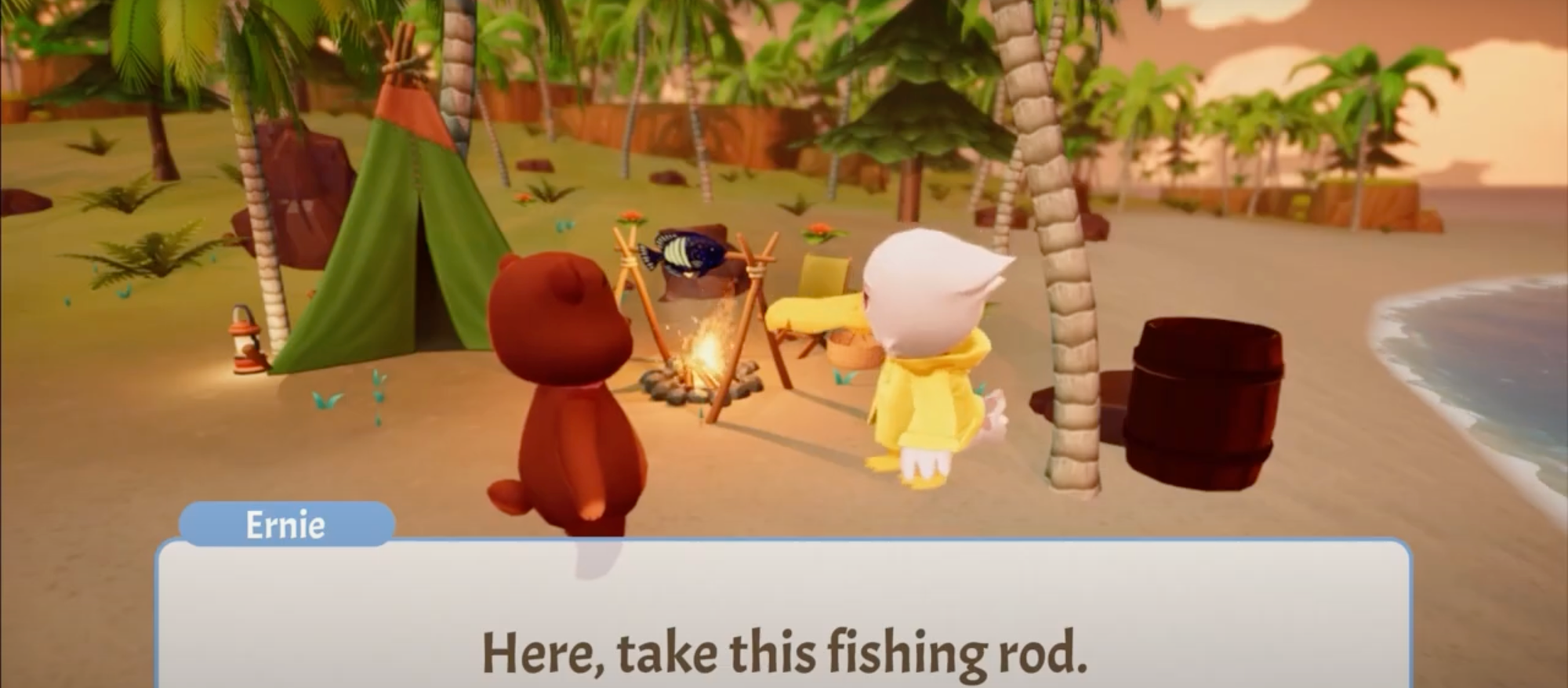
What distinguishes Beratone from other cozy sims is the seamless loop between off‑chain identity and on‑chain value. Viewers can tip creators in BERA, which the streamer could then stake to unlock rarer seed packets that can only be purchased with PoL-eligible asset emissions. Because the studio recycles a portion of marketplace royalties into validator‑boosting BGT, high‑profile streamers actually raise network security as they chase cosmetic bragging rights, fulfilling Berachain’s “fat apps, thin protocol” (otherwise known as the fat bera thesis) ideology.
Wizzwoods attacks the opposite extreme: real‑time, social‑driven spell casting that begins before a wallet is even created by users. The game launches inside a Telegram bot where wizards incant emoji spells to claim land tiles in a procedurally generated forest. Each tile is minted as an NFT only after players bridge to Berachain, but critical early actions - guild invitations, lore drops, battle cries - are signed through Twitter and ingested via an oracle.
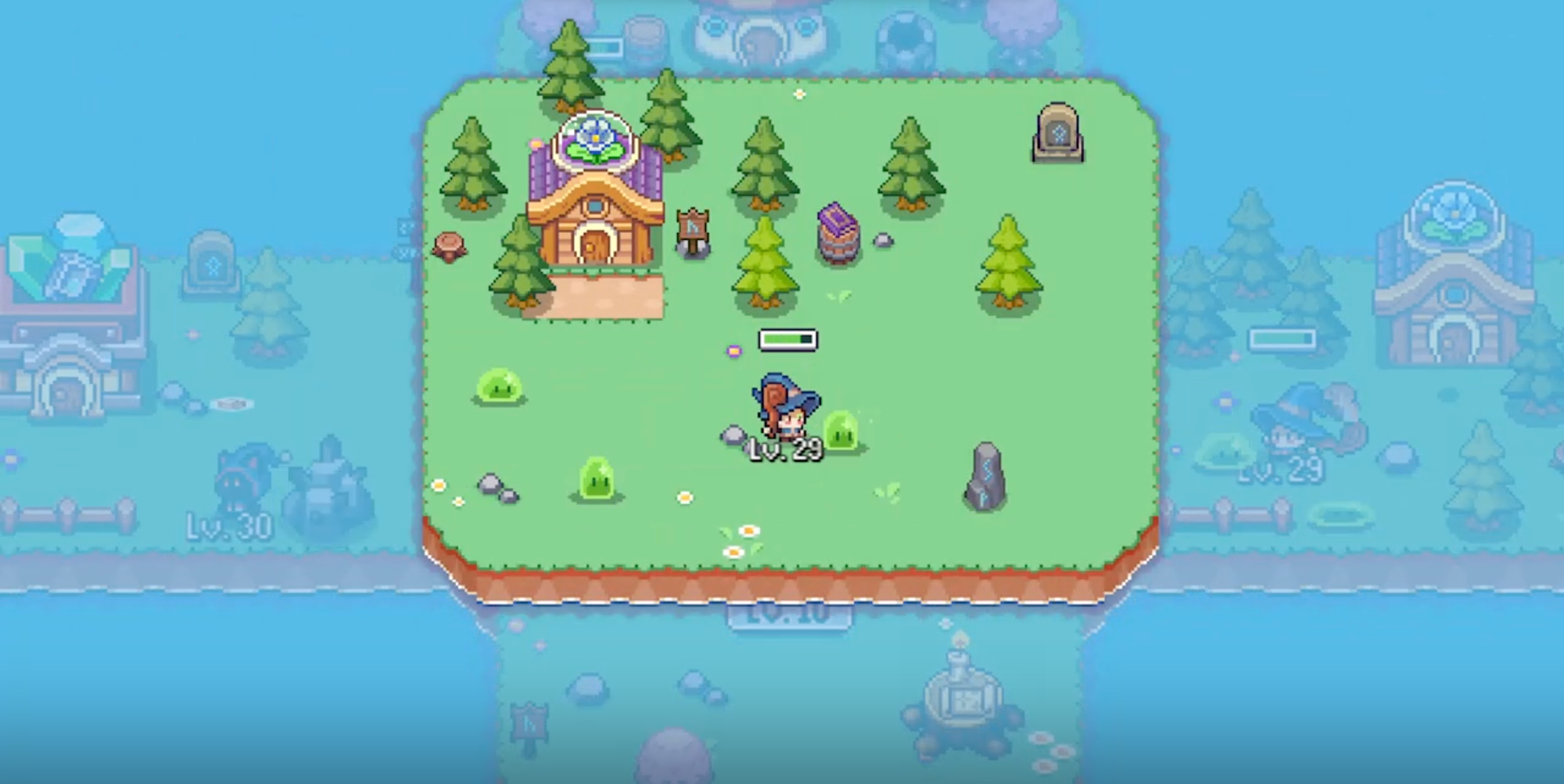
This design accomplishes two things.
First, it leverages the social graphs that gamers already inhabit, meaning recruitment costs are paid in memes rather than wallet-based friction. Second, the torrent of micro transactions generated by every tweet is settled (in batches) through a single BERA‑denominated vault, so network gas is paid once per block, rather than the more costly once per click. The result is a game that feels off‑chain until the moment loot needs to change hands, a slight of hand made feasible only because Berachain’s validator accounting lets backend scripts distribute PoL rewards at a rapid cadence to accommodate experiences like Wizzwoods’.
Beraji’s JIKO has been working to blur the lines between DeFi and PvP card battlers on Berachain, and the team’s latest PREDICTION update pushes that blend even further.
Players can now call short‑term market direction and have those calls buff or debuff their decks in real time; you can also sit ringside and forecast other players’ battles from a front‑row perspective to earn from the sidelines. Crucially, this isn’t gated behind deep strategy knowledge: JIKO lets you predict on familiar tickers - BERA, ETH, SOL, BTC - so even newcomers can participate with a thesis they might already have about the broader market, even if it’s their first time on Berachain.
The result is a feedback loop where macro instincts and game outcomes reinforce each other, and attention to Berachain native markets becomes a skill expression inside the game itself.
Beraji's staking interface rounds out the entire experience by giving players chain‑native ways to position for those calls.
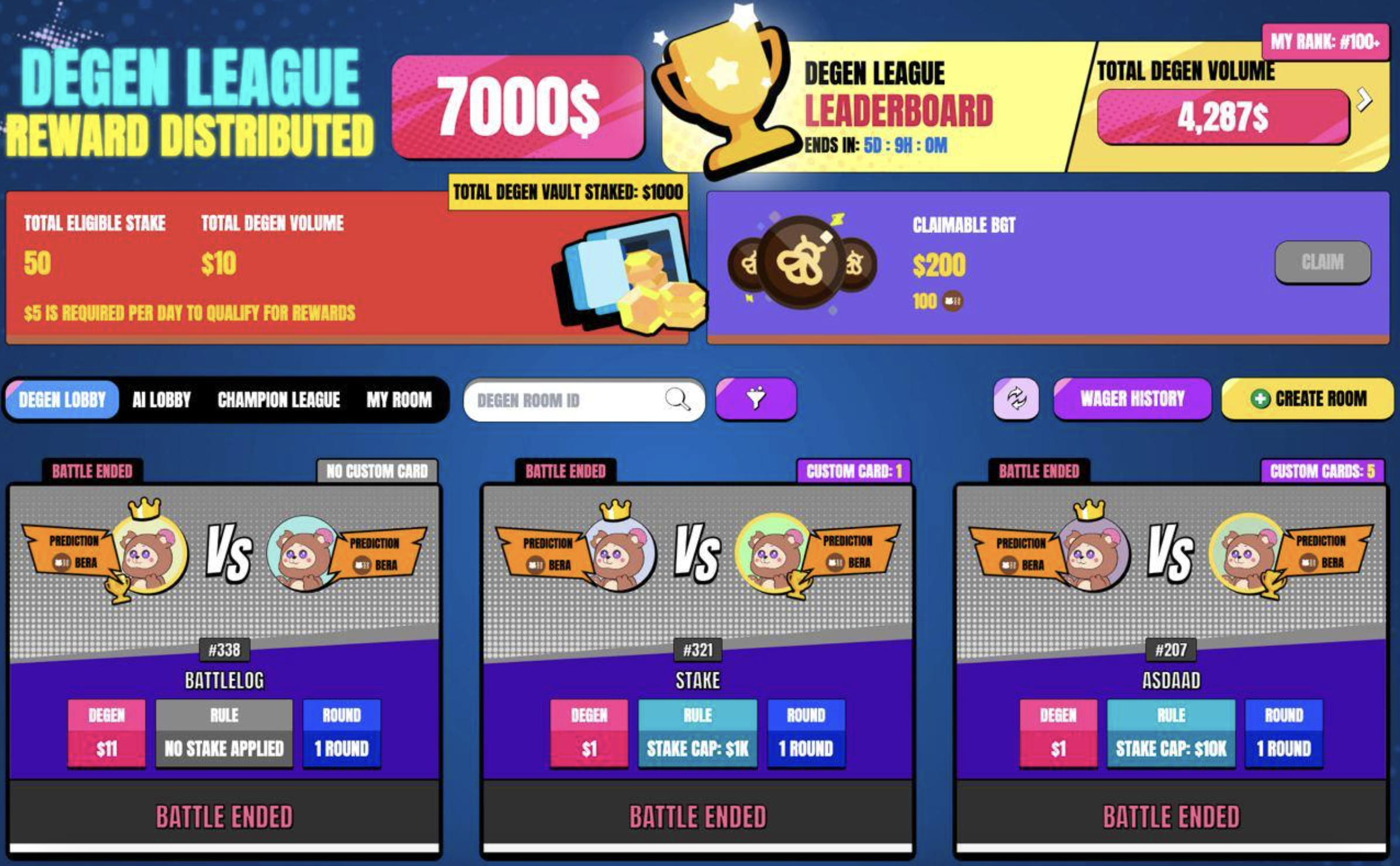
Inside the JIKO app you’ll find single‑sided staking pools and whitelisted token staking with flexible and structured options, not requiring any complicated LP micro-managing. Under the hood, JIKO describes itself as a yield optimizer that taps PoL rails on Berachain, so staking becomes the foundation for your deck economy rather than a side quest outside of the main user flows of the app.
In practice, it means you can stake, play, and compound inside a singular interface: stake in a JIKO pool, queue into battles, and then use that earned staking yield plus prediction wins to level cards or chase tournaments without constantly hopping between dashboards.
Bull Ish could not be more different in tone: a satirical idle clicker game where cartoon cattle spank bearish idols in an endless breadline for the ingame currency, MOOLA. What looks like mindless fun is actually an elaborate liquidity bootstrapping machine.
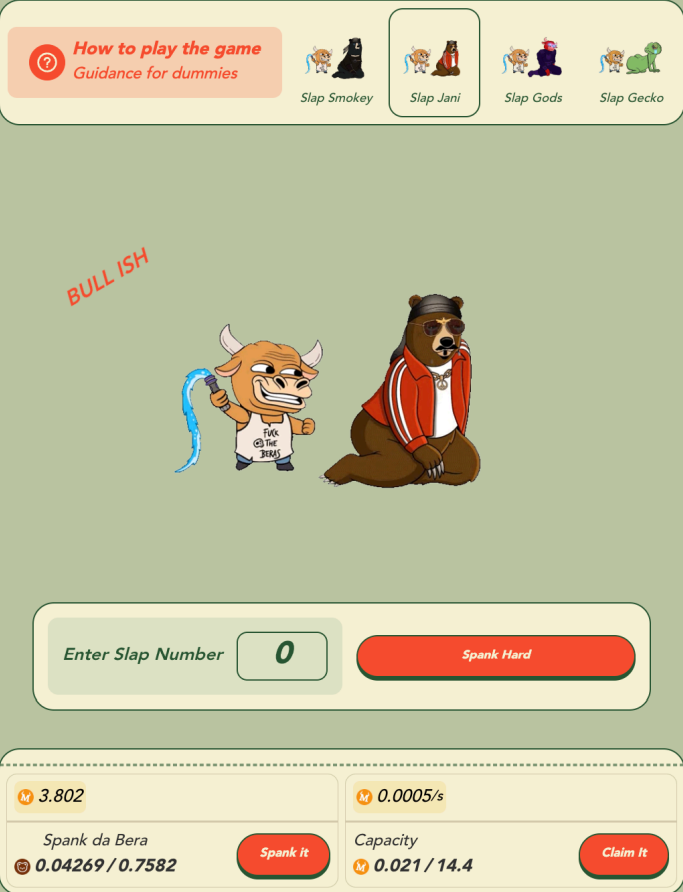
Players who lock larger BERA or LP positions increase their spanking power, accelerating MOOLA earnings that can be converted into oBERO and, subject to governance approval, routed into BGT emissions via Beradrome’s market‑maker. An activity that many chains would treat as a vanity mini‑game thus becomes a liquidity accelerator that tightens spreads on the flagship BERA‑USDC pair. The studio’s art style and general game direction might distract you from its more sophisticated risk modeling: MOOLA inflation follows a dynamic curve that flattens whenever aggregate liquidity drops below a preset threshold, protecting the token against the hyper‑dilution that so often ruins click‑to‑earn economies.
Beramonium Chronicles rounds out the cohort with a lore rich idle RPG, “Gemhunters,” whose design goal is to weave the bears into an extended universe that feels collectible instead of purely financial. Players send their heroes out onto multi hour expeditions that consume BERA, collect gems of various rarities, and burn those gems for NFTs - they might be BeraTone seed packets, Wizzwoods spell scrolls, or Bull Ish cattle skins.
Because each project contributes items to the loot table, cross promotion is baked into progression: a BeraTone farmer chasing a rare watering might find themselves grinding Gemhunters dungeons, thereby deepening their stake in the ecosystem. Blockchains have always stood out as vastly capable pieces of financial infrastructure, but this gradual shift toward gaming and cross-protocol compatibility are what make it so special.
From an incentive standpoint, the elegance lies in how mission fees flow. Half of the gas spent on expeditions buys BGT on Beradrome and locks it in a community vault; the other half rewards explorers in BERA - paid out only if the player has delegated at least a nominal amount of BERA to the PoL yield module. The loop marries retention with validator alignment in a way that pure off‑chain idle games cannot replicate.
What else can be built on Berachain?
The promise of PoL V2 is that it converts BERA itself into a more integral asset while leaving BGT vaults untouched, creating a dual asset canvas for designers.
One near‑term avenue is hyper‑casual mobile games that monetize through attention rather than lootboxes. Imagine a Flappy Bera clone where each ad‑free run costs a fraction of a cent in BERA, but high score leaders reclaim more than they spend because the studio has pre‑bonded BERA for reward‑vault access.
The player’s profit is funded by PoL emissions, yet the studio never touches a secondary token - a user experience far closer to the norms of the app store than to arcane yield farming layouts. Another ripe genre is on‑chain auto battlers.
By whitelisting their hero token as a standardized incentive asset under PoL V2, developers could let players park benched units in liquidity vaults between tournaments, earning emissions that translate into stat rerolls when the next season begins.
This mechanic replaces the traditional battle/season pass revenue model (popularized by games like Fortnite) with what is essentially a treasury bill: players advance their roster while growing chain liquidity, and the game's team sidesteps any potential accusations of pay‑to‑win because power creep is denominated in more skillful or deliberate vault management rather than fiat purchases. Prediction market mini games also stand to benefit in this scenario.
Sports betters could lock BERA as a liquidity backstop, place wagers in a stablecoin‑denominated layer, and earn yield from the bonded BERA while their tickets are pending. Loss‑making positions incur an opportunity cost, not an absolute one, softening the psychological blow of risk and potentially broadening the demographic willing to try on‑chain betting.
Fantasy sports platforms could extend that logic into perpetual markets. Weekly line‑ups might settle on Berachain Perps, with over‑collateralised pools hedged through fixed‑emissions streams earmarked for high‑volume dApps. The key here is latency: because PoL rewards accrue every block, prize pools can scale dynamically with the number of active entrants, an approach impossible on chains that distribute staking rewards in epoch intervals.
The arrangement removes middlemen, and crucially offers amateur organizers the same economic tooling previously reserved for Tier‑1 leagues.
Paths forward
Teams choose Berachain because the chain’s incentive architecture lets game design dictate token economics, rather than the other way around.
A casual player who buys BERA on a centralized exchange will soon see a “delegate for yield” toggle next to the withdraw button, and, once clicked, every subsequent transaction inside any Berachain game can rebate a portion of its gas cost from the player’s own yield stream. For non‑crypto natives, the conceptual barrier shrinks to something as familiar as airline miles or cashback points.
Scaling the ecosystem from boutique curiosities to mainstream hits will hinge on three vectors.
The first is experience abstraction: e‑mail logins, session keys and seamless fiat on‑ramps must remove every trace of RPC jargon. The second is regulatory related. Casino‑inspired titles will probably need provably fair randomness, age gates and transparent house‑edge disclosures if they are to stay on the right side of global gambling statutes. The third is liquidity infrastructure: as sub‑tokens proliferate, a native AMM‑as‑a‑service that routes incentives automatically could prevent fragmentation and keep spreads tight without burdening studios with market‑making overhead.
Vibrant games attract players, players stake BERA for yield, rising stake raises validator income, validators recycle yield into deeper liquidity, and deeper liquidity entices more to come and build unique experiences and businesses on Berachain. In that scenario the chain’s DeFi roots and playful bear‑branded front‑end become complementary parts of the same vision: a blockchain where attention itself is securitized.
The playground is open, and the next wave of builders only needs to come and start playing with the toys.